


Your calendar is bursting at the seams, but your profits are melting away in a price war with the competition? In the finishing and branding industry, the answer isn’t hiring more people – it’s changing what you sell. Get to know the niche high-margin services that premium clients happily pay a higher rate for. Take a look at our shortlist and grab a ready-made, three-month rollout plan you can launch as early as next week.
What are examples of high-margin services in the UK fit-out industry?
The most commonly cited examples of high-margin services in the UK fit-out, branding and advertising industry are:
- installing acoustic panels,
- wayfinding with a navigation audit,
- applying hygienic coatings,
- eco-friendly wall branding using plants.
These examples are easy to roll out and relatively cheap, but they have one big drawback: they’re popular.
To earn a healthy margin and protect it from the competition, go for niche services. The kind you can only deliver after proper preparation or after investing in the right equipment.
We analysed the market and, from many available options, hand-picked our TOP 3. The choice wasn’t random. We based it on market data and the shifting needs of premium clients. So why these three?
- First – the market demands innovation. As Customer Matters reports, as many as 56% of clients actively look for the most innovative companies1, meaning those that consistently bring new products and services to market based on modern technology.
- Second – the key is understanding the B2B client. The State of the Connected Customer report2 shows that 80% of business clients are more willing to buy if a supplier shows a deep understanding of their individual needs. Today’s businesses are looking for contractors who’ll take specific logistical and image-related problems off their plate.
- Third – eliminating the most expensive mistake, downtime. The Aberdeen Group report puts the average cost of an hour of operational paralysis at around $260,000 in the IT industry3. For managers in HoReCa, retail or corporate offices, the mechanism is exactly the same. Shutting a venue for a traditional refurbishment generates enormous losses. The services we’ve chosen let you carry out the work without interrupting your client’s day-to-day operations – and businesses will gladly pay a premium price for that.
| Service name | What is it? | What is the client really buying? Core business value | Why is the margin high? | Main applications and industries |
|---|---|---|---|---|
| #1: UV wall printing | Automatic printing of photorealistic graphics directly onto walls, furniture or doors using a specialised printer. | Clean, quiet installation with zero business downtime (no dust or mess), personalised spaces, a premium feel. | High entry barrier (equipment from around £13,000 net limits the competition), automated work (the printer runs by itself). | Offices, hotels, restaurants, showrooms, fit-out companies, advertising agencies, mural artists. |
| #2: Smart Glass films | Applying PDLC film to existing glass, allowing you to change its transparency at the click of a button. | Privacy on demand, flexible spaces and a modern „wow” effect – no refurbishment or glass replacement needed. | Pricing based on business outcome, uniqueness and the combination of advice, design and installation. | Conference rooms, shop windows, commercial and office spaces. |
| #3: Next-generation LED lighting | Shaping flexible silicone LED strips into any form and mounting them on backings (acrylic, wood) or directly on the wall. | A unique interior character, brand recognition and free social media exposure (the „Instagrammable” effect). | Low material cost, with pricing based purely on the unique effect and design advice. | Restaurants (above the bar), boutiques (backlit logos), hotel lobbies, places designed for customer photos. |
Service #3: Next-generation LED lighting
We’re counting down from third place, because we’ve deliberately saved the best for last.
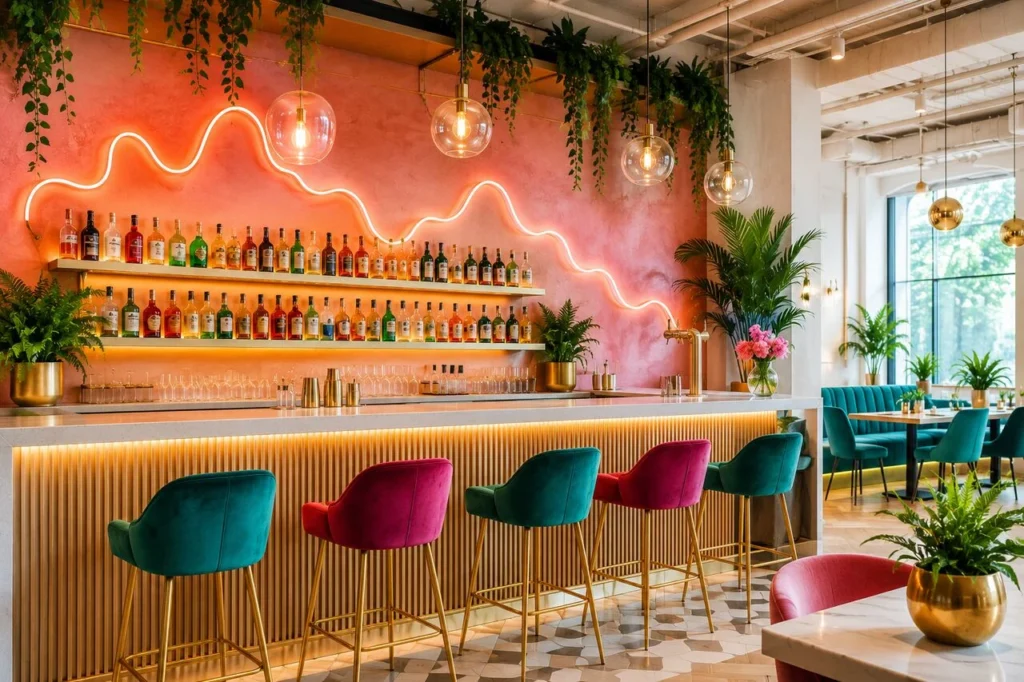
LED neon is a silicone strip with LED diodes that can be bent, cut and shaped into any form (letters, logos, illustrations, abstract shapes). It’s mounted on acrylic, plywood or wooden backings, or fixed directly onto the wall.
The client isn’t simply buying metres of cheap material. The low cost is meant to be a benefit for you, not the client – they gain something else entirely. The pricing reflects the value of the effect, because the client is buying an element that defines the character of a space, builds brand recognition and generates organic reach on social media.
The high margin comes down to three factors. The material cost is low and unclear to the client (unlike a metre of paint or a roll of wallpaper). Pricing is based on the effect and the uniqueness of the design, not on hours worked or material used. The entry barrier requires design expertise and material know-how, which keeps competition limited.
Plenty of Google reviews for companies offering this service back this up. Clients keep highlighting one specific thing: this kind of service is really about advice and design.
A restaurant with a neon sign above the bar, a boutique with a backlit logo, a hotel with a lobby installation. Each of these places can become the backdrop for photos that customers share online. Thanks to your neon, the venue owner gains free advertising created by their guests – but only when the space is genuinely Instagrammable.
The Verge wrote about this phenomenon a few years ago, pointing out that designing spaces in the hope of being tagged on social media is now standard practice4.
Service #2: Smart Glass films
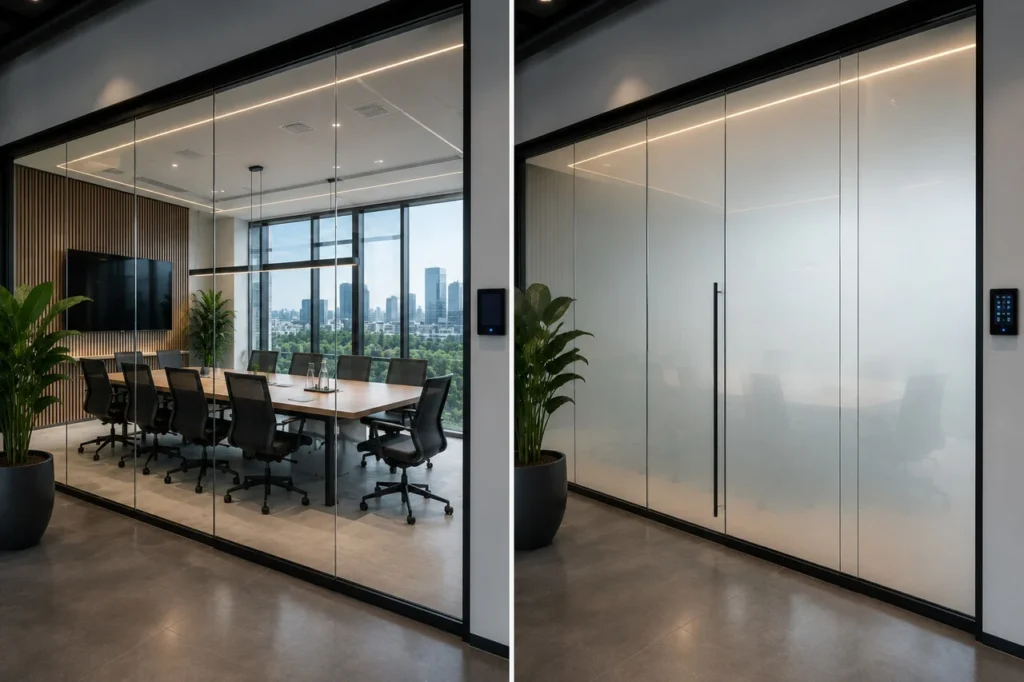
PDLC film is a material applied directly to existing glass surfaces. It doesn’t require replacing the glazing or any building work. Here, the client is buying privacy on demand, a flexible space and an effect that genuinely impresses everyone who sees it for the first time.
Examples? A conference room that becomes private in a split second. A shop window that turns into a screen for simple brand animations at night. Clients pay willingly for these solutions because they solve a specific architectural or communication problem with no refurbishment and no complicated logistics.
The high margin comes from the same mechanism as with LED neons. It’s based on the effect and the value of the solution. On top of that, the service combines installation, technical advice and design, which naturally justifies a higher rate.
PDLC film is a tool for managing space and communicating a brand visually. And that’s exactly how it should be presented from the very first sentence of the sales conversation, if you want to lock in a high margin.
Service #1: UV WALL PRINTING
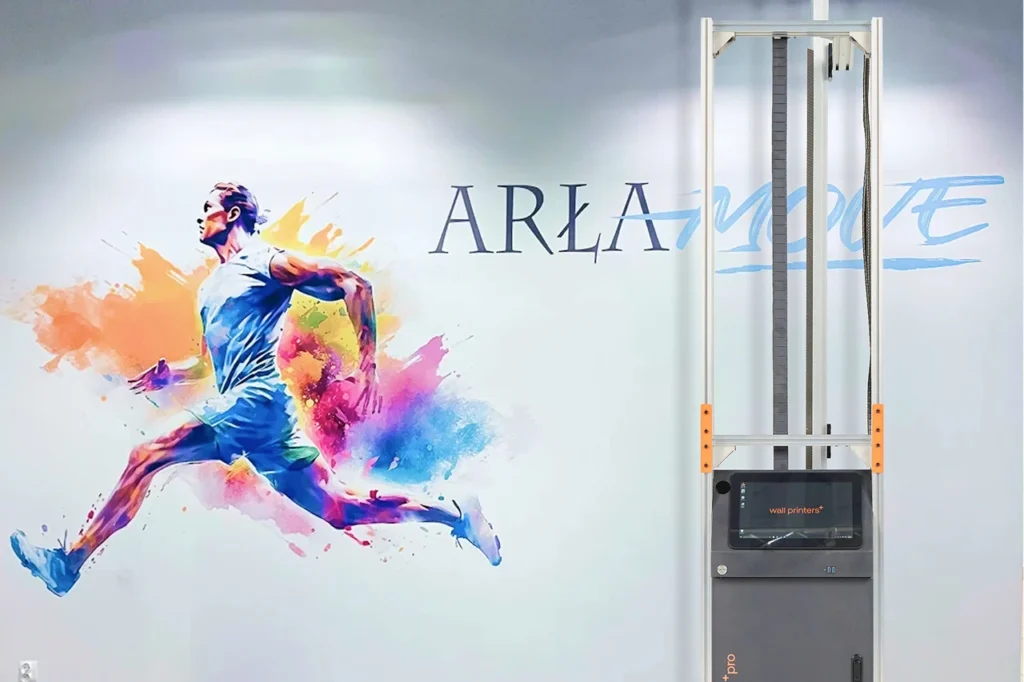
The wall printer moves along the surface and applies UV ink directly onto the substrate. The result: photorealistic graphics.
Parallel income streams on a single site
The wall printer⁺ pro works for you while you handle another job in the same room. You can crack on with painting, wayfinding or installation work, so you can maximise your income streams.
A market with room to grow – forecasts to 2033
The global wall printing market is showing solid growth. Forecasts point to expansion from $1.97 billion in 2024 to $3.86 billion by 20335. This kind of growth proves there’s rising demand for personalised wall decoration solutions.
Where does the high margin on wall printing come from?
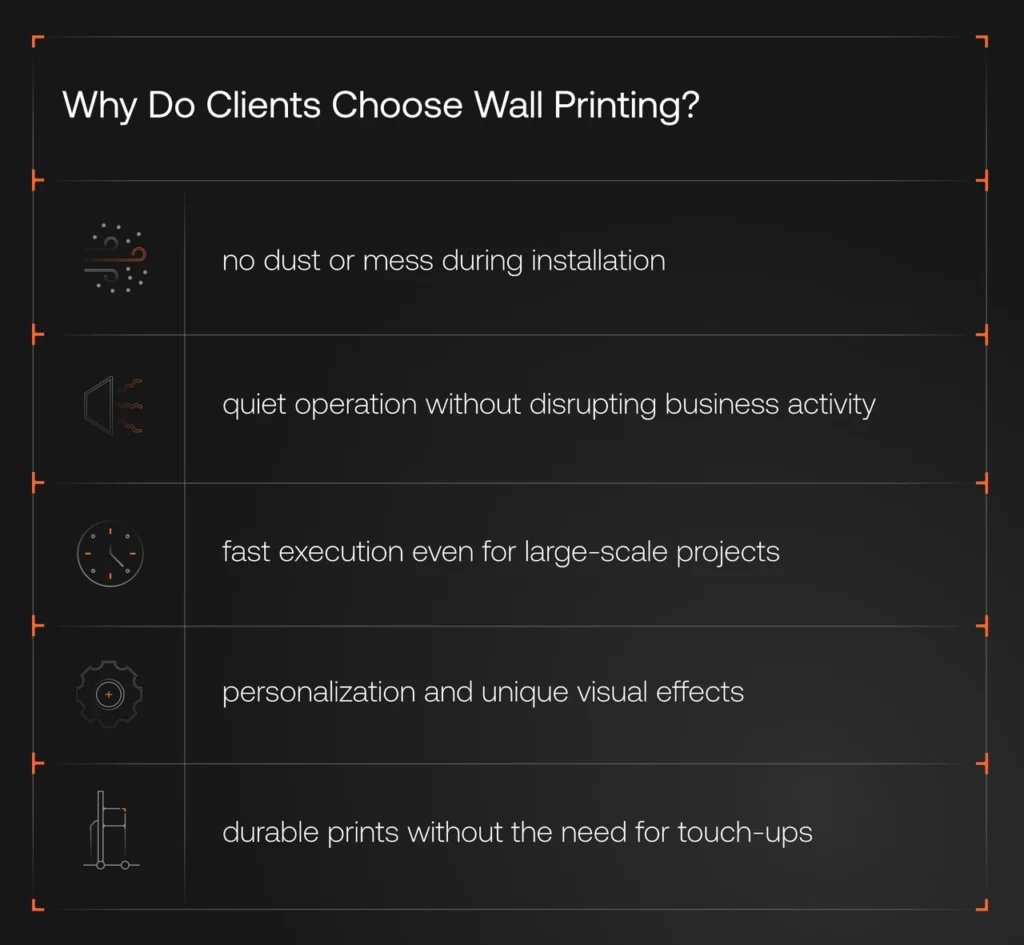
So where does the high margin come from in this case? From how unusual the solution is, the automation of the work and the huge benefits for the client.
The noise level is low, which means you can print in an active office, hotel or restaurant without disrupting the work going on around you. On top of that: zero mess, zero dust, no need to cover furniture and carpets. For a business owner who can’t afford any downtime, that argument often matters more than the price.
Despite all the upsides, it’s still an uncommon solution because of the entry barrier – buying the kit. Companies that decide to invest naturally build an advantage over those that haven’t taken the plunge. And the fewer companies offering the same service in your region, the more stable your pricing position and the less pressure to drop your rates.
The investment and the return – the real numbers
The wall printer⁺ pro with a full ink set costs from £13,000 net (with a leasing option available). The return on investment? A single larger project can bring in as much as £2,000 in revenue. Prices of consumables are stable.
For standard printing (with no white underprint), ink costs come to up to £4 per m² against a market rate of £60 net per m². When printing on dark or coloured substrates, where a white underprint is needed, ink costs rise to around £8 per m², but the price for the job goes up to £100 net per m². In both cases, you’ll recoup your investment after roughly 160-280 m² of printed surface.
And because wall printing lets you grow revenue without hiring extra crews, you can offer a premium service in a space where traditional fit-out work is fighting for every single percentage point of margin.
Who is wall printing for? The industries that will gain the most
Wall printing works brilliantly as an upsell. Need some examples of companies that could add this service to their offer? A fit-out firm can wrap up a project without handing the decoration budget over to someone else. Mural artists can cut their delivery time from weeks to days. Advertising agencies and space branding studios get a tool for precisely reproducing a client’s visual identity.
The practical uses are wide-ranging. Restaurants, hotels, offices, showrooms, retail – basically anywhere a space needs to communicate a brand or simply look great for the people spending time in it.
Printing isn’t limited to walls. Furniture, doors, fittings, furniture board. Every job on a non-standard surface means a higher price tag and narrower competition.
Want to see how rolling out wall printing in a fit-out and branding company actually looks in practice? We’ve got an episode about it on YouTube.
What are high-margin services and what are some examples? Fit-out, decorating, and B2B advertising agencies
The line between a regular well-paid job and a high-margin service isn’t only about how much is left in your pocket once you’ve covered the costs. The real key is what the client is actually paying for – and how you can use that to your advantage.
High-margin services are design-and-build services where know-how, personalisation, advice and the visual outcome dominate, and the cost of materials is only part of the final price.
A standard product vs a business benefit
With a well-paid standard job, the client pays for: scale, time and volume.
For example: you’ve got 2,000 m² of office space to paint in one colour, or 50 large-format information boards to print and apply in a new office building. You’ll issue a hefty invoice, because the project is huge, but you’re pricing it by the metre or by the unit.
It’s a different story with a high-margin service. Here, the client pays for unique know-how, design and the solution to a business problem.
You’re not selling metres of painting. The client pays you because you print graphics on the wall of a pool, in a spa or on a building façade, you offer them a 5 to 10-year guarantee, and you finish with the argument that the wall is scratch-resistant the moment it’s applied, so they don’t have to close the business even for a day. Those are real business benefits.
The cost of materials vs the price of knowledge
In a standard well-paid job, your costs (labour, materials, equipment) rise in proportion to the size of the job.
With high-margin services, on the other hand, fixed and material costs are low compared to the final price.
For an original design and overseeing its rollout in an office building, you can charge a premium rate, while your main cost is the designer’s time and your advice – not materials and labour hours.
Replaceable vs expert
In standard jobs, the client is in the stronger position.
They know that if your fit-out crew or print shop quotes too high, they can send a request for quotation to five other companies with a similar profile. You’re only competing on deadline and price.
With high-margin services, the balance shifts. You’re seen as an adviser and an expert, not just a contractor.
If a mural agency has its own signature style (or works with well-known artists), and a design studio offers unique space branding that shapes a company’s culture, the client wants specifically you. Price drops to second place.
How do you choose the right high-margin service for your business?
Before you settle on specific services, you need to figure out which one is the right fit for you.
To start, ask yourself three simple questions.
- What jobs do you take on most often, and where’s the natural, logical place to expand your offer?
If your company mainly does shop fit-out work, LED neons could be a great fit. If you specialise in things like signage and branding, wall printing is the obvious next step.
- Where are your clients leaving money with someone else?
Watch your projects. After you wrap up, does the client hire another company to install lighting, apply specialist films or advise on space design? Every situation like that is a signal pointing to untapped potential.
- What can you realistically roll out within the next 90 days?
An honest answer to this question will save you from decision paralysis and let you focus on what’s possible right now. Take into account how safe the investment is, the competition in your region and your own knowledge.
How do you start a business built on high-margin services? A concrete 90-day rollout plan
Picked the service you’re interested in? Inspiration without action is worthless. This concrete, 90-day timeline will help you turn interest into real change in your business.
MONTH 1: Preparation
The first month is about laying the foundations. The goal is to make a well-informed decision and put together a solid plan before you spend a single penny.
- In the first two weeks, focus on the decision and research. Go back to the matrix from the first part of this article and honestly judge which service fits your current business model, resources and ambitions best. Check who in your region is already offering similar services, how they position them and at what prices. Your goal isn’t to copy – it’s to find your own niche.
- In the third week, move on to investment planning.
Build a realistic budget, factoring in the cost of essential equipment, training and certifications. Think about what’s absolutely necessary at the start and what can be added later on.
- Use the fourth week for conversations with material and technology suppliers.
Collect quotes, ask for samples, test different solutions. This is the stage for building relationships that will be key further down the line.
MONTH 2: Implementation
The second month is the time for building skills inside your team. This is the stage where theory turns into practice.
- The first two weeks are about gathering knowledge intensively.
Decide who on your team will be responsible for the new service and focus on developing them. Remember: this is an investment that will pay back many times over. At this stage you can lean on free resources: industry blogs and YouTube videos.
- In the third week, if the plan calls for it, buy the equipment.
Get to know it inside out, and in the case of buying a wall printer⁺ pro, book yourself onto in-person training.
- The fourth week is for testing and fine-tuning the process.
Run your first trial jobs. The goal is to spot every potential issue and polish the process before you offer the service to your first paying client.
MONTH 3: Launch
The third month is the moment you go to market. Time to turn the new skill into revenue.
- In the first two weeks, focus on landing your first projects.
Think about who in your company will be responsible for selling the new service and how to present it. The easiest route is often an upsell – chatting with current, trusted clients and offering them a new solution as part of a project you’re already running. At the same time, start communicating the new service to the outside world.
- Use the last two weeks of the month to deliver those first jobs and document them carefully.
Every stage, from design to final result, should be photographed and described. This material will become your first crucial case study – your most powerful sales tool and the foundation for building your expert reputation in the months ahead.
High-margin services – how to shift your market position
Adding a prestigious high-margin service to your offer fundamentally changes how the market sees you.
This way, you move from being an anonymous contractor competing on price to being a partner who solves business problems and is properly paid for what they know.
The companies growing today in the fit-out and branding industry aren’t just doing more of the same. They’re moving into services the competition doesn’t yet understand, and they’re changing what clients are willing to pay for.
All it takes is one good decision and 90 days of consistent action. You’ve got the plan. The only question left is: what will you start with?
FAQ – High-margin services for fit-out and branding companies
Check out the answers to the most common questions.
1. How is a high-margin service different from a regular well-paid job?
In a standard job, the client pays for scale, metres and labour hours. In a high-margin service, they pay for know-how, the result and the solution to a business problem. That way, your fixed costs stay low, while the final price reflects the value you bring to the client.
2. What are some examples of high-margin services in the fit-out and branding industry?
The highest and safest margins come from: UV wall printing, Smart Glass (PDLC) intelligent films and next-generation LED neon lighting. These are niche services that require specialist knowledge or equipment, which naturally limits the competition and protects your pricing position.
3. How much does it cost to enter the UV wall printing business, and when does it pay for itself?
The wall printer⁺ pro with a full ink set costs from £13,000 net, with leasing available. For standard printing (no white underprint), ink costs come to up to £4 per m² against a market rate of £60 net per m². When printing on dark or coloured substrates, where a white underprint is needed, ink costs rise to around £8 per m², but the price for the job goes up to £100 net per m². In both cases, you’ll recoup your investment after roughly 160-280 m² of printed surface.
4. Where do I start when rolling out a high-margin service in my company?
Start with an honest assessment of where your clients are leaving money with other contractors, and what you can realistically roll out in 90 days. The fastest route is an upsell to your current, trusted clients within projects you’re already running – before you start investing in external communication.
- Customer expectations are at an all-time high!, Customer Matters
↩︎ - State of the Connected Customer, Salesforce
↩︎ - The True Cost of Downtime, Aberdeen Group
↩︎ - Instagram is pushing restaurants to be kitschy, colorful, and irresistible to photographers, The Verge
↩︎ - Wall Printing Business Success: 2025 Market Analysis, Financial Viability & Growth Opportunities, Wall Printer Master
↩︎

